02/21/2026
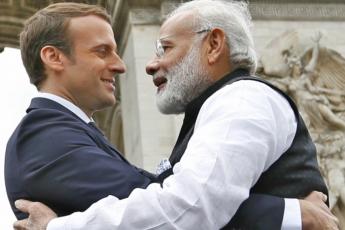
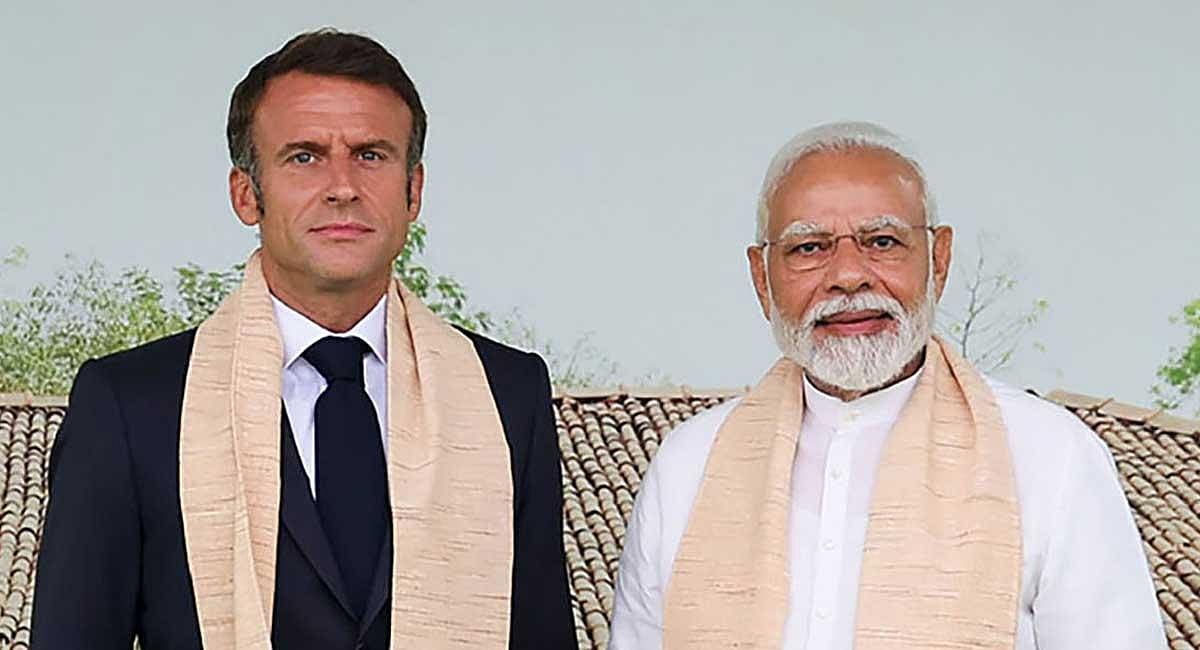
New Delhi, Feb. 21: Indian Prime Minister Narendra Modi and French President Emmanuel Macron on tuesday virtually inaugurated the Final Assembly Line for Airbus's H125 helicopters in Vemagal, Karnataka. Developed in conjunction with the Indian aerospace firm Tata Advanced Systems, this partnership — the latest in a series of bilateral agreements — marked a step forward in a long history of defence ties between the two countries.
This was Macron’s fourth visit to India in as many years. But even as US President Donald Trump continues to shake down the post-World War II established global order, how has France managed to remain important for India? We explain.
In the aftermath of World War II, France’s political ideology was captured by then President Charles De Gaulle in his memoirs: “All my life, I have thought of France in a certain way… dedicated to an exalted and exceptional destiny.” Its universalism, sovereignty, and national importance are deeply rooted in “Gaullism”: a concept aimed at promoting centralised state affairs and a strong national identity.
Part of this was the idea of the domaine réservé (reserved domain): codified in 1958, it introduced a constitutional mechanism to act as an antidote to a legislative gridlock. This semi-presidential system granted the President the power to rapidly execute long-term strategic commitments with foreign actors, insulated from internal parliamentary frictions and domestic disagreements.
France’s structural independence and refusal to deploy its troops under American control resulted in its abrupt withdrawal from NATO’s integrated military command in 1966 (which it officially rejoined in 2009). For India, this incident in history offers reassurance that for the French, national interest trumps over Anglo-American consensus. It also helped France to transition from being a colonial power holding enclaves like Pondicherry (now Puducherry) to becoming one of India’s most dependable Western allies.
French foreign policy is pragmatic: engagement with other countries is on the basis of mutual strategic and economic interests rather than ideological alignment. Unlike the US, France signs defence or trade agreements without attaching conditions or diplomatic barriers such as adherence to certain moral standards in terms of domestic policies or human rights.
This pragmatism also translates into a powerful diplomatic shield at the UN Security Council, where France has effectively replaced Russia as a defender of Indian interests. Be it the refusal to sanction India following the 1998 Pokhran-II nuclear tests or blocking China-backed Pakistani efforts to internationalise the revocation of Article 370 in 2019, France has consistently shielded India from total Western isolation — even at the risk of crossing its own Western bloc.
Although bilateral ties have continued to grow over the years, some instances of potential discord have persisted.
Bilateral goods trade hovered around $15.2 billion in the financial year 2024-25, of which India’s exports constituted just over $7.5 billion. During the first eight months of FY 2025-26 (April-November 2025), Indian exports to France fell by 11%, driven by a massive collapse in refined petroleum exports.
Then there is the proposed 9,900 MW Jaitapur nuclear power project, stalled since 2009. The bottleneck is a legal clash: France’s state-owned electric utility firm EDF refuses to accept the supplier liability mandated under India’s Civil Liability for Nuclear Damage Act, 2010 (now replaced by the Sustainable Harnessing and Advancement of Nuclear Energy Act, 2025). Even as France backs India globally, it demands that the Indian state bear the total financial risk of a potential nuclear disaster.
Setting up facilities like the one in Vemagal could bring jobs, but true technological sovereignty would require securing intellectual property as well. Replacing a historical reliance on Russian hardware with a modern reliance on French hardware — without deep transfers of technology — would merely swap one dependency for another.
Although France remains India’s most reliable Western anchor, New Delhi might have to do more in leveraging this relationship to achieve true strategic autonomy.-Agencies


Tehran, June 21: As India presses ahead with Operation Sindhu to evacuate its citizens from Iran amid intensifying hostilities in the Middle East, the Indian Embassy in Tehran has announced that, upon formal requests from the governments of Nepal and Sri…
Kathmandu, Nov. 24: The joint training exercise "SURYA KIRAN-XVII" of Nepali Army and Indian Army is starting from 24 November 2023 in Pithoragarh, India. The Nepalese army team that will participate in the exercise, which will be attended by the…
New Delhi, May 5: Indian Prime Minister Narendra Modi will be the guest of honour for this year’s Bastille Day Parade in Paris scheduled to take place on July 14. In a statement, the Ministry of External Affairs (MEA) of…