
07/14/2023
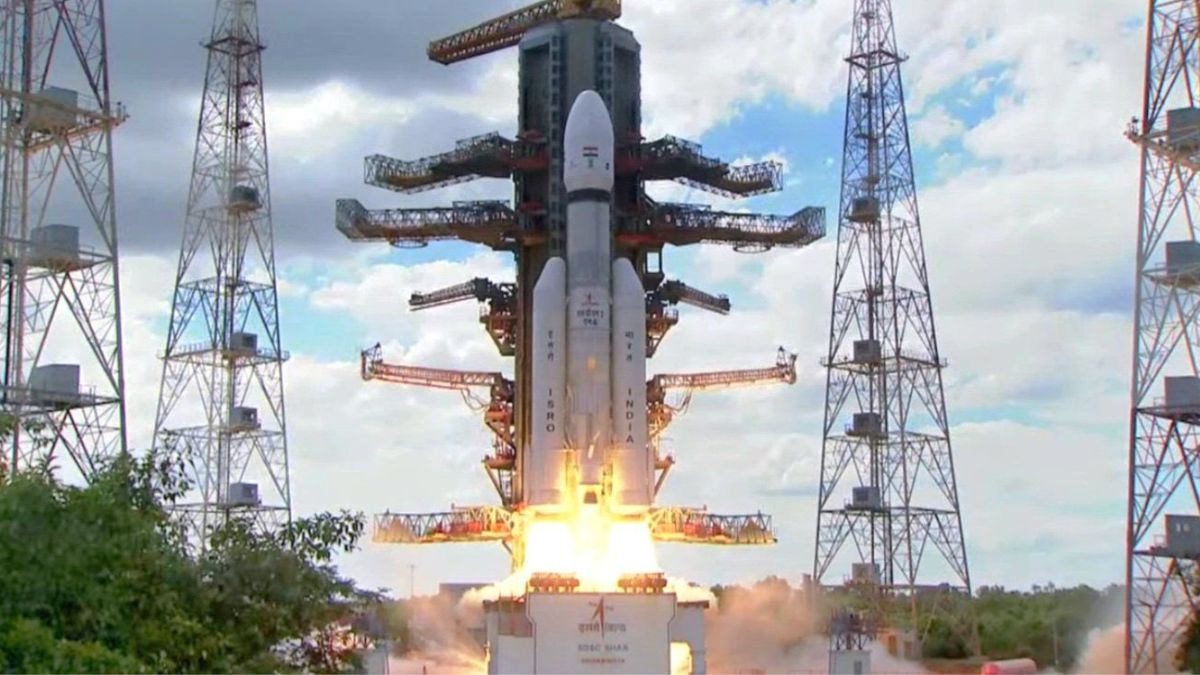
Sriharikota, India, July 14: An Indian spacecraft blazed its way to the far side of the moon Friday in a follow-up mission to its failed effort nearly four years ago to land a rover softly on the lunar surface, the country's space agency said.
Chandrayaan-3, the word for "moon craft" in Sanskrit, took off from a launch pad in Sriharikota in southern India with an orbiter, a lander and a rover, in a demonstration of India's emerging space technology. The spacecraft is set to embark on a journey lasting slightly over a month before landing on the moon's surface later in August.
Applause and cheers swept through mission control at Satish Dhawan Space Center, where the Indian Space Research Organization's engineers and scientists celebrated as they monitored the launch of the spacecraft. Thousands of Indians cheered outside the mission control center and waved the national flag as they watched the spacecraft rise into the sky.
"Congratulations India. Chandrayaan-3 has started its journey towards the moon," ISRO Director Sreedhara Panicker Somanath said shortly after the launch.
A successful landing would make India the fourth country — after the United States, the Soviet Union, and China — to achieve the feat.
The six-wheeled lander and rover module of Chandrayaan-3 is configured with payloads that would provide data to the scientific community on the properties of lunar soil and rocks, including chemical and elemental compositions, said Dr. Jitendra Singh, junior minister for Science and Technology.
India's previous attempt to land a robotic spacecraft near the moon's little-explored south pole ended in failure in 2019. It entered the lunar orbit but lost touch with its lander that crashed while making its final descent to deploy a rover to search for signs of water. According to a failure analysis report submitted to the ISRO, the crash was caused by a software glitch.
The $140-million mission in 2019 was intended to study permanently shadowed moon craters that are thought to contain water deposits and were confirmed by India's Chandrayaan-1 mission in 2008.
Somanath said the main objective of the mission this time was a safe and soft landing on the moon. He said the Indian space agency has perfected the art of reaching up to the moon, "but it is the landing that the agency is working on."
Numerous countries and private companies are in a race to successfully land a spacecraft on the lunar surface. In April, a Japanese company's spacecraft apparently crashed while attempting to land on the moon. An Israeli nonprofit tried to achieve a similar feat in 2019, but its spacecraft was destroyed on impact.
With nuclear-armed India emerging as the world's fifth-largest economy, Prime Minister Narendra Modi's nationalist government is eager to show off the country's prowess in security and technology.
India is using research from space and elsewhere to solve problems at home. Its space program has already helped develop satellite, communication and remote-sensing technologies and has been used to gauge underground water levels and predict weather in the country, which is prone to cycles of drought and flood.
"This is a very critical mission," said Pallava Bagla, a science writer and co-author of books on India's space exploration, adding that India will require soft landing technology if it wants to attempt more missions to the moon.
India is also looking forward to its first mission to the International Space Station next year, in collaboration with the United States as part of agreements between Modi and U.S. President Joe Biden at the White House last month.
This one-off visit by an Indian astronaut to the International Space Station will not hamper India's own program, which aims to launch an Indian astronaut from Indian soil on an Indian rocket in late 2024, Bagla said.
As part of its own space program, active since the 1960s, India has launched satellites for itself and other countries, and successfully put one in orbit around Mars in 2014.
Singh said that based on the current trajectory of growth, India's space sector could be a trillion-dollar economy in the coming years.
As of April, India has launched 424 satellites for 34 countries, including Israel, the United Arab Emirates, Kazakhstan, the Netherlands, Belgium and Germany. The ISRO has earned approximately 1.1 billion rupees ($13.4 million) in the past five years from the launch of foreign satellites, the minister told India's Parliament in December.-Agencies




Tehran, June 21: As India presses ahead with Operation Sindhu to evacuate its citizens from Iran amid intensifying hostilities in the Middle East, the Indian Embassy in Tehran has announced that, upon formal requests from the governments of Nepal and Sri…
Kathmandu, Nov. 24: The joint training exercise "SURYA KIRAN-XVII" of Nepali Army and Indian Army is starting from 24 November 2023 in Pithoragarh, India. The Nepalese army team that will participate in the exercise, which will be attended by the…
New Delhi, May 5: Indian Prime Minister Narendra Modi will be the guest of honour for this year’s Bastille Day Parade in Paris scheduled to take place on July 14. In a statement, the Ministry of External Affairs (MEA) of…